II-V-I

Two Easy 2 5 1 Jazz Guitar Licks in F Major - Tab and YouTube Short Videos
Here are two easy jazz guitar licks published on JGL's Facebook, Youtube and Instagram pages, based on a 2 5 1 sequence in F major (Gm7 | C7 | Fmaj7) implying two arpeggios and a minor triad.

10 II V I Jazz Guitar Licks For Beginners
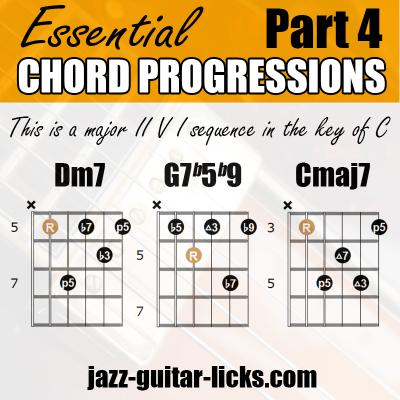
The II-V-I sequence is the most common chord progression played in jazz music and a must know for any guitarist who wants to learn jazz language.
The II, the V and the I (chords and scales) are constructed based on the corresponding second (II), fifth (V) and first (I) step of the major scale.
In this guitar lesson you will learn what's the 2 5 1 progression and how to play easy jazz lines over a 2-5-1 using the most common scales found in jazz music.

How to Use a Tritone Substitution - 6 Guitar Licks
 What's a Tritone Substitution?
The tritone substitution is one of the most common substitution found in jazz. The basic application of a tritone chord substitution is to take any 7th chord and play another 7th chord that has its root a tritone away from the original. This guitar lesson demonstrates how you can play scales and arpeggios starting from the b5 (a tritone away) of the V7 chord in a II V I chord progression. This way you will highlight altered tones as the b9 and the #11.

Triads On Guitar - Lesson With Tabs & Shapes
Triads are one of the first harmonic tools to study. They are very useful for comping and chordal enrichment.
Learning close and open (aka spread) triads increase your harmonic knowledge and at the same time help you discover your fretboard.
In this lesson you will see the main triad chord shapes including root positions and inversions.
You will also find some ideas on how to use triads over a II V I sequence, in order to create interesting melodic movement in your comping.

The 14 Most Important Jazz Chord Progressions
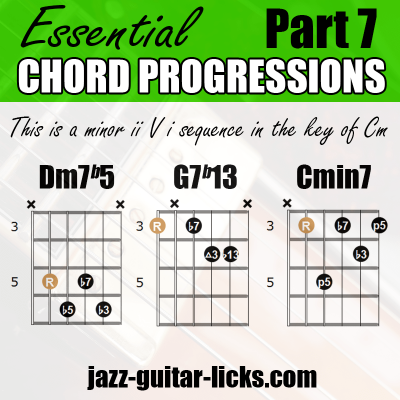
In this lesson you will learn to recognize 14 important jazz chord progressions as minor and major II-V-I, turnarounds and their variations, how to use diminished passing chords...etc.
You will also find charts with roman numerals to easily transpose these harmonic progressions in different keys and some examples of comping with audio files, tabs and standard notation.
How to Play a Major 7th Arpeggio Over a Dominant 7 Chord
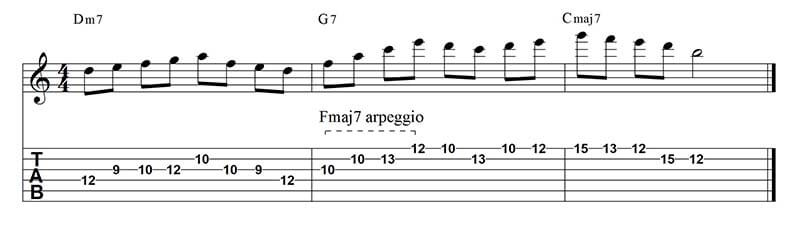 When a jazz beginner starts to improvise over a II-V-I progression, he generally plays arpeggios corresponding to the chords of the sequence.
In other words, he learns to play minor arpeggios over the minor chord (II), dominant 7th arpeggio over the 7th chord (V) and major arpeggio over the major 7 chord (I). This way the harmony is highlighted without taking risks.
In the long-run there is nothing exciting. That's why there is a nice trick used by number of jazz players to add smoothness to a dominant line. This is a little tip that makes all the difference which consists of playing a major 7th arpeggio over the V7 rooted on its b7 degree.

Jazz guitar chord voicings - II-V-I progression - 5 Exercises
The ii–V–I progression is the foundation of jazz harmony and one of the most important chord sequences every guitarist must master. Found in countless standards, it creates the essential tension and resolution that defines the jazz sound.
In this lesson, you’ll learn how to play jazz guitar chord voicings over a ii–V–I progression through five practical exercises, helping you move efficiently across the fretboard while developing a more authentic jazz comping sound.

New eBook available | 50 exercises for jazz guitar | II-V-I voicings
 A new eBook is available for download. It contains 50 exercises with guitar tabs and standard music notation that will show you how to use different types of voicings over a II-V-I progression. This PDF eBook will help you to understand how the main jazz guitar chords are built (minor 7, major 7, dominant 7, diminished 7, half-diminished, augmented, 7b5, drop 2, drop 3, inverted, altered, extended and rootless chords) and how to apply chord substitutions (diatonic sub, tritone sub and diminished substitutions).

The Tritone Substitution - Guitar Lesson With Theory and Tabs
The tritone substitution sometimes referred to as dominant chord substitution is one of the most popular harmonic technique found in jazz and other styles of music.
It involves replacing a dominant seventh chord with another dominant seventh chord located a tritone (or augmented fourth) away from the original chord's root.
The 2 5 1 Progression - Guitar Lesson with Shapes , Tabs and Licks
The major 2 5 1 sequence is the most common chord progression used in jazz music but also in a whole number of styles of music as pop, rock, blues, country.
It is present in many jazz standards (Summertime, Autumn leaves, Blue bossa, All the things you are and many more), this is why it is very important to master it.

What Are Guide Tones and How to Use Them