Posts by jazz-guitar-licks

How to Make Sure Your Guitar Is Setup
 By
Stef Ramin
By
Stef Ramin
Taking care of your equipment is essential.
Guest post by Glen Parry
Whether it’s your car, PC, or your guitar, in order for it to work properly and as for long as possible, you need to make sure that everything’s in order.
Sure, you could take your guitar to a professional and have them do it for you, but why not learn to do it yourself?
Not only will you save money and time, but you will also learn a thing or two about your instrument.
Here are some quick and straightforward tips that will make setting up your guitar a piece of cake!

The Blues Arpeggio - How To Mix Major And Minor Triads
By
Stef Ramin
 What's the Blues Arpeggio ?
Traditionally, when a student learns to improvise over a jazz, blues tune, he taught pentatonic scales, major triads or dominant 7th arpeggios, but there is something missing to get this specific and exciting jazz-blues sound, "The Blues Arpeggio". This is a very interesting and important device to use over this musical genre. It is a mix of a major triad and a minor triad, it contains both major and minor thirds, representing one of the most vital elements of the blues. In this jazz guitar lesson we will see how to build the blues arpeggio, how to practice it and how to play it on a blues.

How to Buy the Best Jazz Guitar Based on Body Type (Guide for Beginners)
By
Stef Ramin
Guest post by Aaron Schulman
While there is no absolute best jazz guitar for everyone, there are definitely a few jazz guitar models that would be a best fit for you.
The trick is to learn enough about the different body styles and electronics to understand the sonic qualities that each jazz guitar expresses.
You’ll want to educate yourself both on the different jazz guitar body styles and manufacturers. The more homework you do, the more your understanding will grow and the more confident you will be in your final purchase decision.

How To Play Jazz Guitar For Beginner
By
Stef Ramin
 Guest post by Marc-Andre Seguin
So, you've decided to try your hand at Jazz guitar. This article will assume a certain base level of proficiency in the general language of music apart from the specific vernacular that informs jazz music, guitarists specifically. Not because it's a theory article, but because if you hope to learn how to play this music (and any style, really) a little knowledge goes a long way. If you have no background in notated music, theory and harmony please pick up Barbara Wharram's Theory For Beginners. It will open the door.

The 14 Most Important Jazz Chord Progressions
By
Stef Ramin
In this lesson you will learn to recognize 14 important jazz chord progressions as minor and major II-V-I, turnarounds and their variations, how to use diminished passing chords...etc.
You will also find charts with roman numerals to easily transpose these harmonic progressions in different keys and some examples of comping with audio files, tabs and standard notation.
How to Play a Major 7th Arpeggio Over a Dominant 7 Chord
By
Stef Ramin
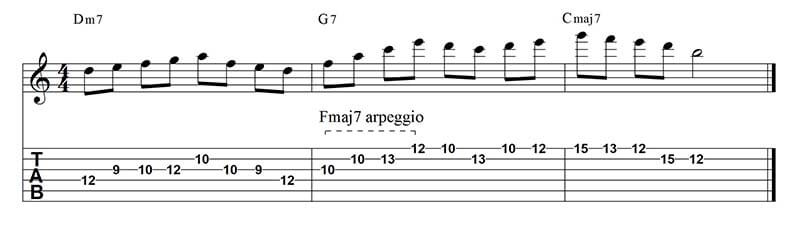 When a jazz beginner starts to improvise over a II-V-I progression, he generally plays arpeggios corresponding to the chords of the sequence.
In other words, he learns to play minor arpeggios over the minor chord (II), dominant 7th arpeggio over the 7th chord (V) and major arpeggio over the major 7 chord (I). This way the harmony is highlighted without taking risks.
In the long-run there is nothing exciting. That's why there is a nice trick used by number of jazz players to add smoothness to a dominant line. This is a little tip that makes all the difference which consists of playing a major 7th arpeggio over the V7 rooted on its b7 degree.
Barry Galbraith jazz guitar study - Like someone - Guitar comping video with bass lines
By
Stef Ramin
A new video has been uploaded on the YouTube channel. It is a Barry Galbraith comping study named "Like someone". This is the last study from the Barry Galbraith book "Jazz guitar comping series, vol #3" published by Jamey Aebersold.
Most of the accompaniments studies (comps) in this book are designed to accompany a melody or an improvised solo with bass lines like a pianist would do. It is a very great book to practice jazz guitar comping.
Is Amp Simulation the Cure for GAS ?
By
Stef Ramin
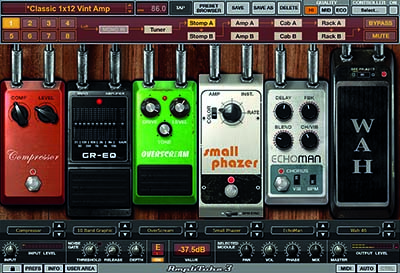 As a guitarist, it’s tempting to spend a lot of time and money on gear. All of us suffer from G.A.S. (gear acquisition syndrome) to some degree. The never-ending search for the ‘perfect’ tone will plague us all. At some point, though, this obsession with gear can distract you from what matters.
For most guitarists, their tone starts with their hands. Guitar choice, amp choice, pedals and everything else comes second to technique. So, I propose an alternative - rather than focusing on GEAR, focus on SKILL. That doesn’t mean tone isn’t important, though. It shouldn’t be disregarded entirely. There is an efficient, cost-effective way to find the right tone in seconds - without ever visiting your local Guitar Center...

8 Minor Pentatonic Sounds Over Dominant 7
By
Stef Ramin
Unlock new colors in your soloing with one of the most versatile tools in jazz guitar: the minor pentatonic scale. While it’s often associated with blues and rock, this simple five-note scale can create rich, modern sounds over dominant 7 chords when used creatively.

Kenny Burrell - In a Mellow Tone - Jazz Guitar Transcription
By
Stef Ramin
A new video has been uploaded on the youtube channel. It is a jazz guitar transcription of the jazz standard "In a mellow tone" composed by Duke Ellington and performed by Kenny Burrell in 1990.
Here is the Kenny Burrell version on which the transcription is based and the link to the album dedicated to Duke Ellington.

List Of Jazz Standards And Keys
By
Stef Ramin
A“standard” or “jazz standard” is referring to a popular music piece and/or jazz music composition that is held in continuing esteem and is frequently used in musical repertoire.
Many of these “jazz standards” were not necessarily originally jazz compositions. Music publishers include the term “jazz standards” in a description or a title they nearly always are referring to compositions used as the basis for improvisation or jazz arrangements.
You will find in this post a non-exhaustive list of jazz standards and their original keys to practice at home or in jam sessions.

Triad Arpeggios - Guitar Lesson For Beginners
By
Stef Ramin
Arpeggios are among the most essential tools to learn when beginning improvisation.
When played over their matching chords, they produce a more harmonically connected sound.
They also make it easier to clearly outline chord changes in solos and improvisations.
This guitar lesson introduces the simplest type of arpeggios, built from three notes, known as “triad arpeggios.”

Jazz guitar chord voicings - II-V-I progression - 5 Exercises
By
Stef Ramin
The ii–V–I progression is the foundation of jazz harmony and one of the most important chord sequences every guitarist must master. Found in countless standards, it creates the essential tension and resolution that defines the jazz sound.
In this lesson, you’ll learn how to play jazz guitar chord voicings over a ii–V–I progression through five practical exercises, helping you move efficiently across the fretboard while developing a more authentic jazz comping sound.

New eBook available | 50 exercises for jazz guitar | II-V-I voicings
By
Stef Ramin
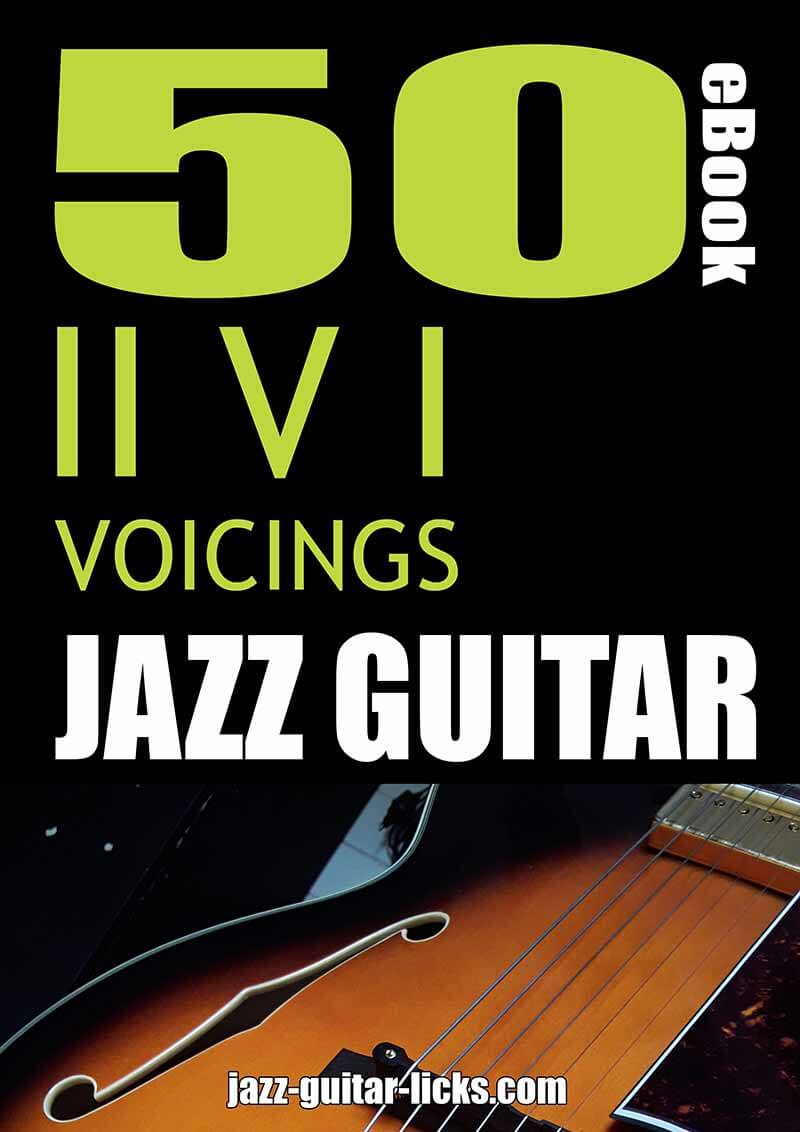 A new eBook is available for download. It contains 50 exercises with guitar tabs and standard music notation that will show you how to use different types of voicings over a II-V-I progression. This PDF eBook will help you to understand how the main jazz guitar chords are built (minor 7, major 7, dominant 7, diminished 7, half-diminished, augmented, 7b5, drop 2, drop 3, inverted, altered, extended and rootless chords) and how to apply chord substitutions (diatonic sub, tritone sub and diminished substitutions).

Minor Pentatonic Scales Over II-Valt-I Sequence - 5 Jazz Guitar Licks
By
Stef Ramin
In this lesson we will see how to use the minor pentatonic scale over a II-Valt-I sequence.
The principle being to play three minor pentatonic scales spaced apart of 1 semitone one from the other in order to bring out interesting colors to your jazz lines.
Sookie sookie - Grant Green - Transcription
By
Stef Ramin
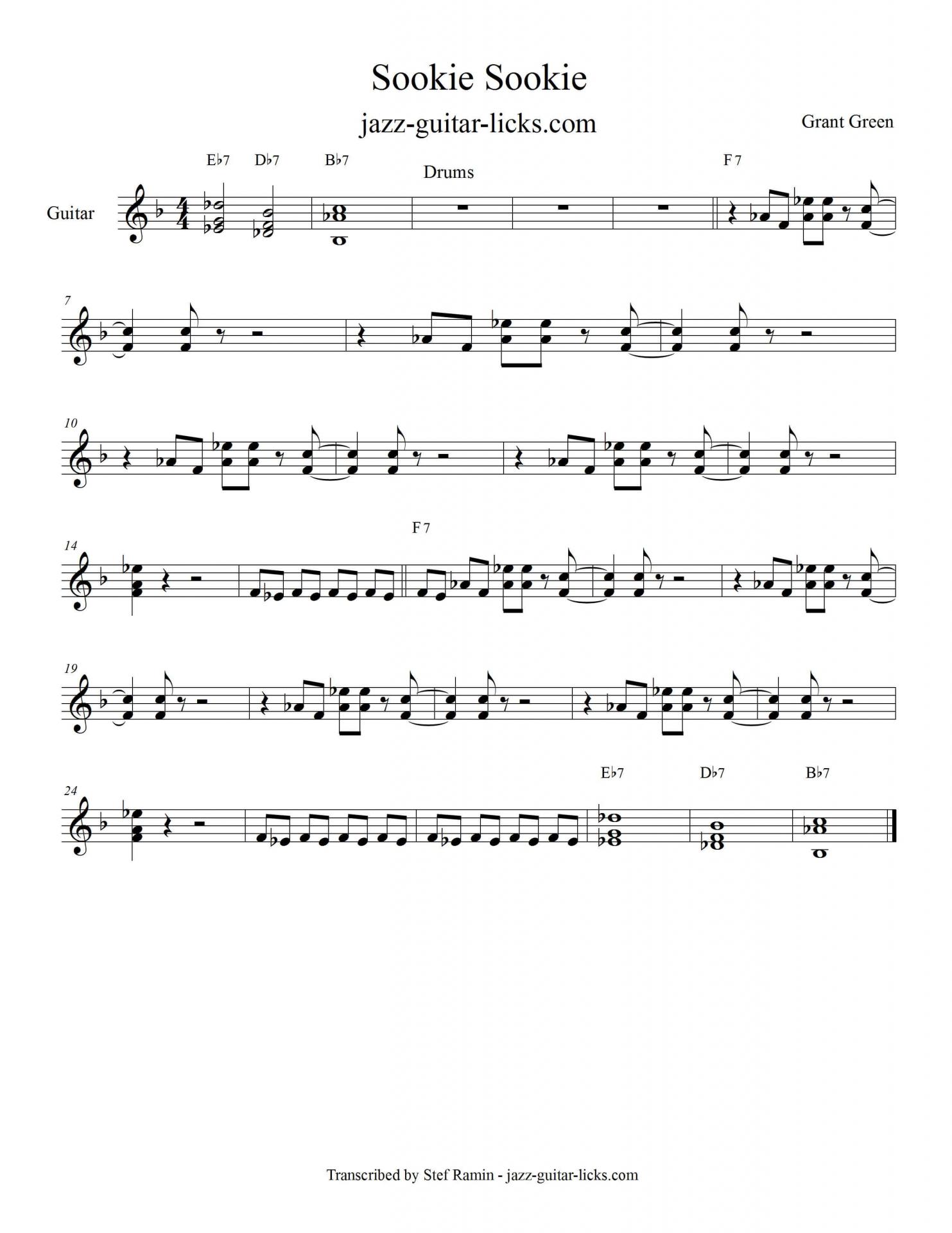
Here is a free transcription of the famous soul-jazz tune "Sookie sookie" by Grant Green.