Posts by jazz-guitar-licks

Voice Leading For Guitar - 5 Easy Exercises
 By
Stef Ramin
By
Stef Ramin
"Voice leading" is a term that refers to the smooth progression of each voice of a chord.
This technique consist to move individually one or several voices up or down by a step from one chord to the next.
This is very used by composers and improvisers in order to connect chords instead of bouncing them around.
The aim of this lesson is to connect or voice-lead basic four-note chords of the same types by moving only one voice.
This should help you learn some of the most important chords used in jazz guitar.

GuitarSim - App & Smartphone Accessory For Guitarists
By
Stef Ramin
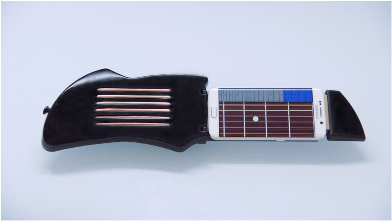
GuitarSim is the smartphone accessory that turns your phone into a mini digital guitar with tons of features. It’s not just your average guitar; Guitarsim leverages your phone to give you a powerful and portable gadget to jam with, and its foldable so you can throw it into your bag without hassle.
Guitar Arpeggio Shapes Infographic
By
Stef Ramin
This guitar infographic takes the main arpeggio shapes namely ,minor 7, major 7, dominant 7, half-diminished and diminished 7.

5 Jazz Tunes Arranged For Chord-Melody You Need To Know
By
Stef Ramin
 Focusing on jazz standards is surely the best way to accelerate the learning process of jazz guitar, making sure to choose easy songs with a few numbers of chords and melodies that can be easy to hear, play and memorize. When learning jazz guitar, it's very important to spend time learning famous jazz songs, it is an essential part of being a jazz musician. Many guitar students are able to play a ton of chords, arpeggios and scales but they can't play a jazz tune mixing both the melody and the chords.
Here are 5 easy chord-melody arrangements of popular jazz songs for beginning jazz guitarists. Each lesson is available for free as a YouTube video with guitar chord diagrams overlayed in real time.
-
Beautiful love (Wayne King, Victor Young and Egbert Van Alstyne)
-
Misty (Errol Garner)
-
Moon river (Henry Mancini)
-
Stella by startlight (Victor Young)
-
Autumn Leaves (Joseph Kosma)

Drop 3 Chords - Guitar Diagrams And Music Theory
By
Stef Ramin
Drop voicings are chords which span more than an octave. They are very useful tools in music composition and arrangement and are greatly appreciated by guitarists for comping and soloing.
There are several types of drop voicings as drop 2, drop 3, drop 3-4, drop 2 and 4 voicings and drop 2-3-4 voicings.
In this lesson you will learn how drop 3 voicings are built and how to play them on guitar.

Autumn Leaves - Easy Chord Melody Arrangement For Beginners - Tabs and chords
By
Stef Ramin
Autumn leaves is one of the most popular non-American jazz standards on pick-up gigs and records. It is a must-know tune for any jazz guitarist and a great choice when you want to play both chords and melody on guitar. This guitar lesson provides an easy chord melody arrangement to play this famous jazz tune.

5 Tips For Learning Guitar Scales
By
Stef Ramin
 Learning to maneuver through scales on your guitar will bring about a ton of benefits to you, as a player. First of all, you'll begin to perceive music a little bit differently – you'll find logic where you ought to think there was none, you'll understand how your favorite composers got their brilliant ideas, and, most importantly, you'll get to put the theory into practice.
What's more, the whole journey of exploring the theoretical sphere of music concerning the scales isn't all that hard. Essentially, you'll found yourself amidst the crossroads, and you'll have to choose a path – you'll either delve deep into books about music theory, or you'll have to figure everything out yourself.
Regardless of the path you wish to take, mastering and learning guitar scales is, quite frankly, easy. We've brought together a short list of five tips that will make the process even simpler, and more entertaining.

How To Play Autumn Leaves - Jazz Guitar Chords - Advanced lesson
By
Stef Ramin
 Autumn leaves is a 1945 song composed by French musician Joseph Kosma. The original lyrics are in French, written by Kosma but in 1947 Johnny Mercer wrote the English ones. Since that time it has become a very popular song and surely one of the most played jazz standards.
This song is in a AABC form (32 bars), very much appreciated by beginners because the harmonic progression is pretty simple to play and easy to understand. It covers a very important chord sequence found in jazz, the ii-V-I both in minor and major.

25 Altered Dominant Guitar Chords
By
Stef Ramin
Altered dominant chords are used to bring tension and an outside flavor to jazz chord progressions.
They generally resolve to an inside chord as the I or a substitute as iii or vi.
They have one or more notes lowered or raised by a half-step, in other words they contain one or more alterations.
These alterations are b9,#9, b5 (#11) and b13 (#5).
Altered Chords are generally used by jazz musicians, composers and arrangers as substitutions for diatonic chords for adding dissonance and spicing up the harmony.

How To Connect Jazz Guitar Chords (Drop 2)
By
Stef Ramin
Drop 2 chords are very important tools in jazz music. They are very useful for comping, chord soloing, harmonizing and building chord melodies.
The first chapter of this lesson provides all the drop 2 voicing shapes, major seventh (M7), minor seventh (m7), dominant seventh (7), half-diminished (m7b5) and diminished seventh (dim7) to play on the guitar neck.
The second explains how to connect them with notes of the major scale.

What Is a Backdoor Progression And How To Play Over It
By
Stef Ramin
In jazz, there are many types of turnarounds and progressions that eventually we all must encounter. A key part of how you practice should be in preparing yourself for these progressions and turnarounds.
Whether that is by learning a shed-full of Parker’s II V I licks, by practicing exercises over progressions or even by learning a new standard.
The end result is that you are better equipped to deal with what is in front of you in the moment on the bandstand.
To this end, I’m going to talk to you today about a progression known as the backdoor progression.

How To Play Pentatonic Scales Over Giant Steps
By
Stef Ramin
Giant Steps is one of those tunes in jazz that sends a bolt of fear through a lot of young or even experienced jazz musicians.
It certainly does that to me anyway! The fast harmonic rhythm and the seemingly distant relationships between the chords means it is a very daunting challenge.
However, there is a very cool and simple way of practicing navigating through these changes and it involves using 3 different pentatonic scales.

Melodic Minor Scale Exercises For Guitar – Position Shifts
By
Stef Ramin
Learning and playing scales can be an important part of any guitarist’s practise regime.
By playing scales in a variety of ways we can develop our familiarity with the fretboard beyond simply going up and down scales.
In this tutorial we will look at combining two different scale patterns by shifting between them on various strings.
For this we are going to use two patterns of an Eb Melodic minor scale, patterns 2 and 3.
The Melodic minor scale consists of the intervals R 2 b3 4 5 6 7 (R is for the Root note).

The CAGED Method For Guitar - Scales, Chords And Arpeggios
By
Stef Ramin
Welcome to this guitar lesson on the CAGED method!
If you're looking to enhance your understanding of the fretboard, The CAGED method is a powerful system that will help you visualize and navigate the guitar in a more cohesive and comprehensive way.

Album Review and lick analysis – Monk – Peter Bernstein
By
Stef Ramin
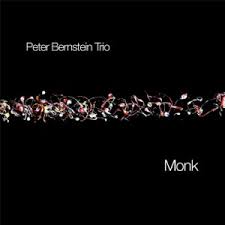 The music of Thelonious Monk is music which evokes many different emotions and ideas in a huge demographic of musicians and instrumentalists. With that in mind, the emotions and ideas evoked by legendary jazz guitarist, Peter Bernstein, in this showcase album range from childish playfulness, faithful to the source of the music, to coherent and thorough modern jazz playing in the upper echelons of technical and interactive ability.
It’s been noted previously in reviews, at the time of the album’s release, that a collection of Monk tunes by a guitarist is a rare occurrence that was a huge breath of fresh air to all those who knew about its existence. I’ve never heard such faithful music made with such individualism and taste without any sense imitation. This is most definitely Bernstein plays Monk and not the other way around.

10 Jazz Blues Tunes Every Beginning Guitarist Should Know
By
Stef Ramin
Building Your Jazz Blues Repertoire
 A big part of learning jazz guitar means building his own repertoire of pieces. Here is a list of 10 jazz blues songs every beginning guitarist should know.
This short list covers a range of jazz blues chord progressions and their different variations (form, tonality, Harmonic structure) with a brief analysis and also represents the most played jazz blues tunes at jam sessions.