The tab examples are all presented using the “parallel approach” in which all the modes are presented in one key, namely C. This helps you hear how each mode sounds without potentially confusing it with one that you played previously.
Mode 1: Melodic Minor. Intervals: 1 2 b3 4 5 6 7
This first mode is typically played over a minor-major 7 chord, as in the first chord of “Nica’s Dream.” Sometimes the sound could be suggested by the melody, as in the opening to “Solar.” In some playing situations, you can just superimpose it over a regular minor 7 chord just because you want to get a more exotic minor sound.
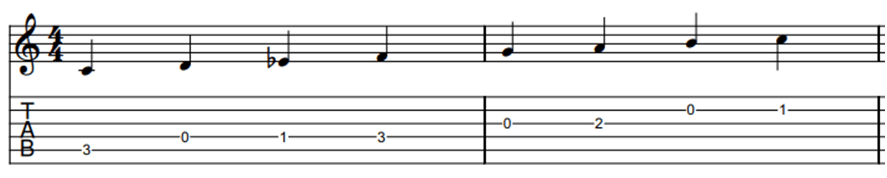
Mode 2: Dorian b2 (or Phrygian Natural 6). Intervals: 1 b2 b3 4 5 6 b7 8.
The second mode is like having a Dsusb9 chord where you would play d eb f g a b c d, which is of course a C melodic minor scale. In “Sail Away,” Tom Harrell uses a “Gsusb9” chord as a type of V chord leading back to C.
The scale used here would be the second mode of an F melodic minor, because by definition the susb9 chord is the second mode and “g” is the second note of the F melodic minor scale.

Mode 3: Lydian Augmented. Intervals: 1 2 3 #4 #5 6 7.
The third mode, like towards the end of “Dolphin Dance,” Herbie Hancock plays a Ebmaj7#5 chord, which would imply eb f g a b c d eb, again a C melodic minor scale. You can try to take any major 7 chord and stretch it into this sound, especially if you have a responsive enough rhythm section.
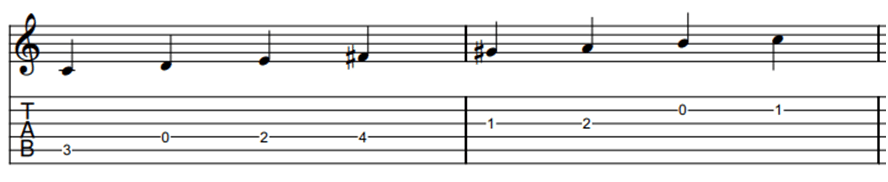
Mode 4: Lydian Dominant. Intervals: 1 2 3 #4 5 6 b7.
The fourth mode is very common and is called the Lydian dominant scale because it has a sharp 4 (lydian) and a flat 7 (dominant). On the Ab7 chord of “Stella by Starlight,” you could play ab bb c d eb f gb ab, which is the fourth mode of an Eb melodic minor scale. You can play this over any flat seven dominant chord, notated as “bVIIx”.

Mode 5: Mixolydian b6 (or Aeolian Dominant). Intervals: 1 2 3 4 5 b6 b7.
The fifth mode is not common because it’s simply an inversion of an I chord. For example, Cminmaj7/G is just a C melodic minor chord, second inversion, so in essence, this is a much-used mode at all.

Mode 6: Locrian Natural 2 (or Aeolian b5). Intervals: 1 2 b3 4 b5 b6 b7.
The 6th mode can be used over both II chords and VI chords. For example, in “Windows” it goes from Bm to G#m7b5, over which you can play g# a# b c# d e f# g#. This is the 6th mode of B melodic minor.
The other type is if you have, let’s say, a II chord Dm7b5 in the key of C and you play d e f g ab bb c d over it. This is the 6th mode of F melodic minor. The Jamey Aebersold books refer to this usage as “half-diminished number 2” or “half-diminished 9”.

Mode 7: Super Locrian (or Altered or Palamidian). Intervals: 1 b2 b3 b4 b5 b6 b7.
The 7th mode is very common and is referred to as the “altered” scale. When you see E7alt, it means e f g ab bb c d e, which is the 1 3 and b7 plus raised and lowered 9th plus raised and lowered fifth.
In “I Thought About You,” the beginning of the second half of the tune is commonly played | Bm7b5 E7alt | A7 D7alt | G7 | and there are a great many more examples. There are two approaches to using this mode of the melodic minor. If the chord is E7alt, the first approach is to go up a half-step and play F melodic minor.
The second way is to think of E7alt as a Bb7#11/E – i.e. because Bb7 and E7 share the same 3rd and 7th (try it for yourself) you can think of the Bb7 as a “tritone substitution” for E7. (It’s called tritone because it’s up 3 whole steps from E.) This may seem like a more complicated way of doing it, but it is actually easier for two reasons.
First, you can just think of it as a Bb Lydian dominant scale, which is a lot easier than thinking about all those altered notes; and second, if your altered chord is a V, i.e. if it was E7alt to A7, then you just have to think “Bb7” (with a raised 4 of course) to “A7” just down a half step, which can be very handy.
If you want to go deeper and practice ear training in all the melodic minor modes explained below, refer to this video (presented in the key of Bb):