If you've spent any time learning guitar scales, you've probably encountered both the Major scale and the Lydian scale. At first glance, they seem almost identical—and in fact, they differ by only a single note. Yet that one note creates a dramatically different musical mood.
Understanding this relationship is one of the fastest ways to expand your improvisation skills and add new colors to your playing.
The Major Scale: The Foundation of Western Music
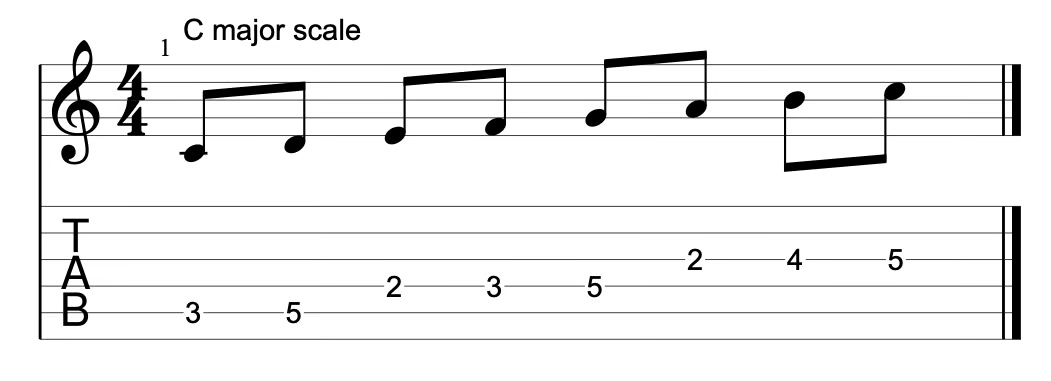
The Major scale, also known as the Ionian mode, is the most familiar scale in Western music. It forms the basis of countless songs across rock, pop, country, jazz, and classical music.
The sound of the Major scale is balanced, stable, and resolved. When people think of a "happy" or "bright" scale, they are usually thinking of the Major scale.
The Lydian Scale: A Brighter Version of Major
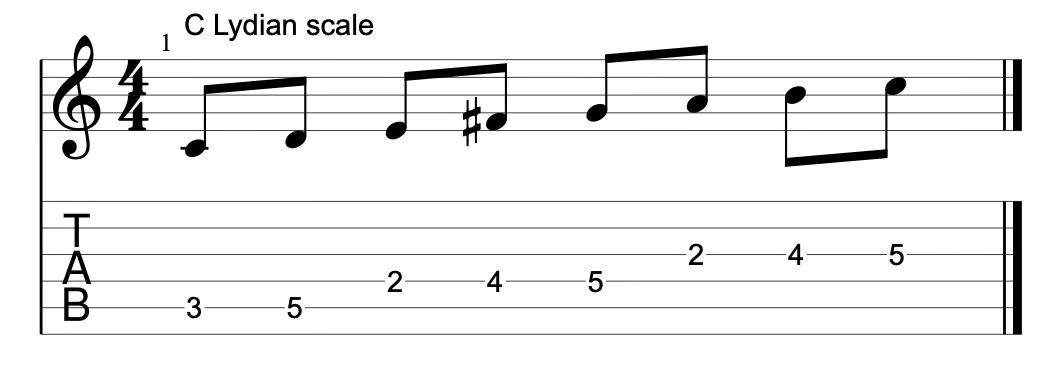
The Lydian scale contains all the same notes as the Major scale except for one important change:
Notice that the only difference is the F becoming F♯.
Although this change appears small on paper, the effect on the listener is significant. The Lydian scale sounds more open, spacious, and modern than the traditional Major scale.
Why Does Lydian Sound So Different?
The secret lies in the raised fourth degree.
In a Major scale, the natural 4th often creates tension against the root chord. In Lydian, raising that note removes some of this tension and replaces it with a more floating, unresolved quality.
This distinctive character makes Lydian a favorite among film composers and progressive guitarists.
Comparative Chart
Feature
Major Scale (Ionian)
Lydian Scale
Formula
1 – 2 – 3 – 4 – 5 – 6 – 7
1 – 2 – 3 – ♯4 – 5 – 6 – 7
Key Difference
Natural 4th
Raised (♯4) 4th
C Scale Notes
C – D – E – F – G – A – B
C – D – E – F♯ – G – A – B
Mode Number
1st Mode (Ionian)
4th Mode (Lydian)
Parent Major Scale
C Major
G Major
Altered Notes
None
♯4
Hearing the Difference
Try this simple experiment.
Play a C major seventh chord and improvise using the notes of C Major:
C – D – E – F – G – A – B
Then replace the F with F♯ and play:
C – D – E – F♯ – G – A – B
You'll immediately hear a brighter, more adventurous sound emerge. That single altered note is the signature color of the Lydian mode.
The Relationship Between Lydian and Major Scales
One of the easiest ways to understand Lydian is through modes.
Every Lydian scale is derived from a Major scale. Specifically, Lydian is the fourth mode of the Major scale.
For example:
C Lydian uses the same notes as G Major
D Lydian uses the same notes as A Major
F Lydian uses the same notes as C Major
This means that if you already know your Major scales across the fretboard, learning Lydian is simply a matter of identifying and emphasizing the raised 4th degree.
Applying Lydian on Guitar
A great way to practice Lydian is to play over a sustained major seventh chord.
For example, try improvising over:
Cmaj7
While soloing, focus on highlighting the F♯ note. The more you emphasize the raised fourth, the stronger the Lydian sound becomes.
Many guitarists use Lydian to create melodies that feel uplifting, sophisticated, and less predictable than standard Major scale lines.
Famous Uses of the Lydian Sound
The Lydian mode appears frequently in rock, fusion, jazz, and film music. Guitarists such as Joe Satriani and Steve Vai often use Lydian melodies to create their signature soaring, atmospheric sound.
Jazz guitar players as John scofield, John Mac Laughlin and Pat Metheny use them a lot to bring tension of major seventh chords.
Film composers also favor Lydian because it evokes wonder, discovery, and a sense of possibility.
Additional points
1. The interval pattern changes
Major: Whole–Whole–Half–Whole–Whole–Whole–Half
Lydian: Whole–Whole–Whole–Half–Whole–Whole–Half
The extra whole step between the 3rd and ♯4 is what creates the distinctive Lydian structure.
2. Lydian is still a major-type scale
Both scales contain a major 3rd and a perfect 5th.
The tonic chord remains major.
This is why Lydian sounds related to the major scale rather than completely different.
3. Lydian is the only major mode with a raised 4th
Among the four major-family modes (Ionian, Lydian, Mixolydian, and sometimes considered major pentatonic-derived sounds), Lydian is unique because of its ♯4.
4. An easy formula to remember
Lydian = Major Scale + ♯4
This is often the simplest definition for guitarists and improvisers.
Lydian Lick
This F Lydian phrase features three sixth intervals: C–A, B–G, and A–F. Incorporating intervallic ideas from the Lydian mode can add fresh melodic colors to your major-scale playing.
Final Thoughts
The Major scale and the Lydian scale are separated by only one note, but that single change opens an entirely new world of musical expression.
Major provides stability and familiarity. Lydian adds brightness, color, and a sense of movement beyond traditional harmony.
If you're looking to move beyond standard Major scale phrasing, start experimenting with the raised fourth. You may discover that the Lydian mode becomes one of the most inspiring sounds in your musical vocabulary.
This Printable PDF eBook available for free download contains 6 easy jazz guitar licks with tabs/notation, youtube video link and analysis about the tritone substitution.
This eBook PDF with audio files contains 25 dominant diminished jazz guitar patterns using the half-whole diminished scale and diminished 7th arpeggios.
You will find here an eBook available in PDF containing 25 soul jazz and hard bop guitar licks in the style of Grant Green, Melvin Sparks, George Benson.
This printable method is available as a PDF file containing 40 easy dominant jazz-blues guitar lines with tabs, standard notation, analysis, audio files and scale charts.
This PDF eBook method contains 25 altered jazz guitar licks with tabs, patterns, scale charts and audio files to master, apply and develop the altered scale.
This jazz guitar method is an eBook available as a PDF with standard notation, guitar tabs, diagrams, analysis, audio files and backing tracks. You will find in this booklet 25 easy jazz guitar lines with theory using common and rare pentatonic scales.
This printable eBook method in PDF format provides 49 jazz solo transcriptions of the greatest jazz musicians. Tab, standard notation, audio files & analysis.
In this package you'll get a printable PDF Method with tabs, notation, analysis, scale shapes and audio files for practicing 30 smooth jazz guitar licks.
This PDF eBook provides over 550 guitar chord shapes. This is the perfect reference guide to understand how chords are built and how to play them on the guitar neck.
Within this package, you'll discover a set of ten chord melody exercises for beginners. Printable PDFaudio files, a backing track, and a link to a YouTube video.
This package provides a printable PDF with exercises and audio files to learn how to harmonize the major scale with 3 note chords and their extensions.
Learn how to harmonize major, minor, harmonic minor, melodic minor and harmonic major scales on guitar. 48-page PDF with chords, arpeggios, tabs and diagrams.
Learn 10 side-stepping minor pentatonic guitar licks for outside playing. Download the PDF guitar lesson with audio files and expand your improvisation skills.
Explore 63 essential jazz guitar chord shapes with clear diagrams and interval names. A reference poster featuring major, minor, dominant, diminished, extended and altered chords.